
Class is now in session as we jump into the upcoming Riftbound: League of Legends TCG!
Are you a fan of League of Legends but have never tried a TCG before? Maybe you're a veteran TCG player and want a quick look at this new TCG? Riftbound: League of Legends TCG is a re-imagine of the popular Mass Online Battle Arena League of Legends in card form! In this game, you take up arms as Champions and play your way to victory, whether that be in a 1v1, Free For All or Team fights! It is reminiscent of League of Legends: Dominion, a game mode centering around objective control. Only by capturing battlefields and gaining 8 points can you win the game and declare yourself as the MVP!
So pick a Champion and queue with us as we break down the intricacies of the Riftbound: League of Legends TCG!
This course is broken down into 5 different sections:
- What is Riftbound: League of Legends TCG?
- Looking at your Cards
- Building your Deck
- Setting up your Base
- Conquering your Battlefield
We will be picking Jinx (from the Jinx Starter Deck!) as our Champion in this article so let's hop right into it!
What is Riftbound: League of Legends TCG?
Riftbound: League of Legends TCG is a running trading card game where you race with your opponents to see who gets to 8 points first. There are two main ways for you to gain points; when you conquer battlefields or when you hold battlefields.
Using cards like Champions from League of Legends, Units, Spells and Gears, you advance your strategy to conquer all battlefields. The game cards also comes in multiple colours or Domains which each have their own characteristics.
FURY (Red) - Aggression, damage
CALM (Green) - Defensive, holding the board state
MIND (Blue) - Removal type control, hidden mechanics
BODY (Orange) - Ramps, big Units
CHAOS (Purple) - Discard, trash interaction (graveyard matters)
ORDER (Yellow) - Go wide, sacrifice, death triggers
Looking at your Cards
Let's first take a look at the different types of cards you will be playing with in Riftbound!
There are 7 card types in Riftbound, including:
- Champion Legend
- Champion Unit
- Unit
- Spell
- Gear
- Rune
- Battlefield
Champions are characters that you can play in League of Legends and this is the same for Riftbound! Champions come in two different card types, mainly Legends and Champion Units.

Legend cards are cards that are only used to define your deck. They are all Champions that you can pick in League of Legends and comes in all kinds of colours or Domains! They cannot be played directly and are usually only there for you to decide the Domains of your deck, the Champion Unit you will be using as your Chosen Champion, as well as any extra triggers or abilities. Champion units on the other hands are playable character cards that you can use to battle and conquer battlefields, just like every other unit. The Chosen Champion will be a Champion Unit that has the same name and Domain as your Legend, and must be placed outside of your main deck but can only be played directly (timing rules apply).
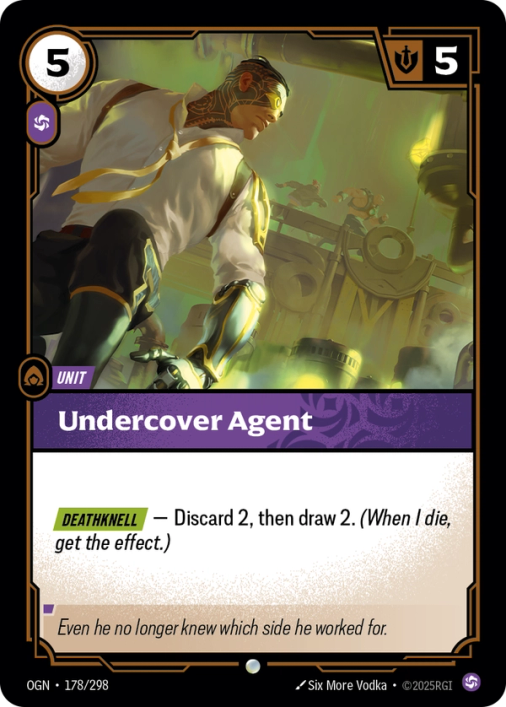
Another important card type to remember are units. Champion Units are a type of unit based on the Champions in League of Legends, however there are many other unit types available for you to use
in your deck. Unit cards will be the cards that you will have the most plentiful of as they are important for gaining points by conquering and defending your battlefields. Many Unit cards will also have strong abilities so make sure to read your cards carefully and strategise around them!
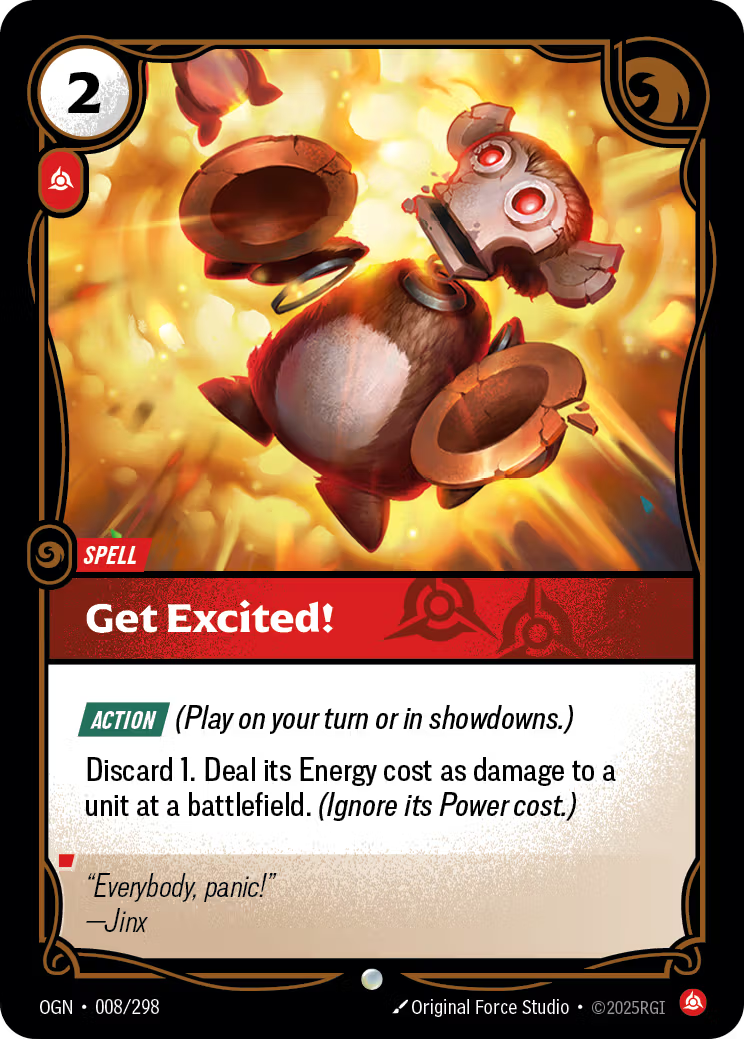
Other than Unit cards, we also have Spell cards! Spell cards are one-time use cards that give you powerful effects! They have abilities ranging from draw and discards, deal damage, buff units, disrupt opponents and more! Spell cards are very useful during battles as some of them include ACTION and REACTION keywords, allowing you to play them during your opponents turn and doing some sneaky combat tricks!

Lastly we can look at gear cards. Gear cards are permanent cards that give powerful effects on the field without being attached to a Unit. This makes Gears quite powerful as it will be harder to remove Gear cards as compared to Unit cards. Its abilities will also be persistent and ongoing as long as it stays on the field. Gears can be powerful if left unchecked so make sure to use them
wisely!
Outside of your Legend, all the cards we have reviewed for now are cards that will be part of your main deck. This means that they are playable and can be used by you to win the game or turn the tides to your favour. Before we move on to look at Battlefields and Runes, let us first break down the anatomy of these cards and see what they signify!

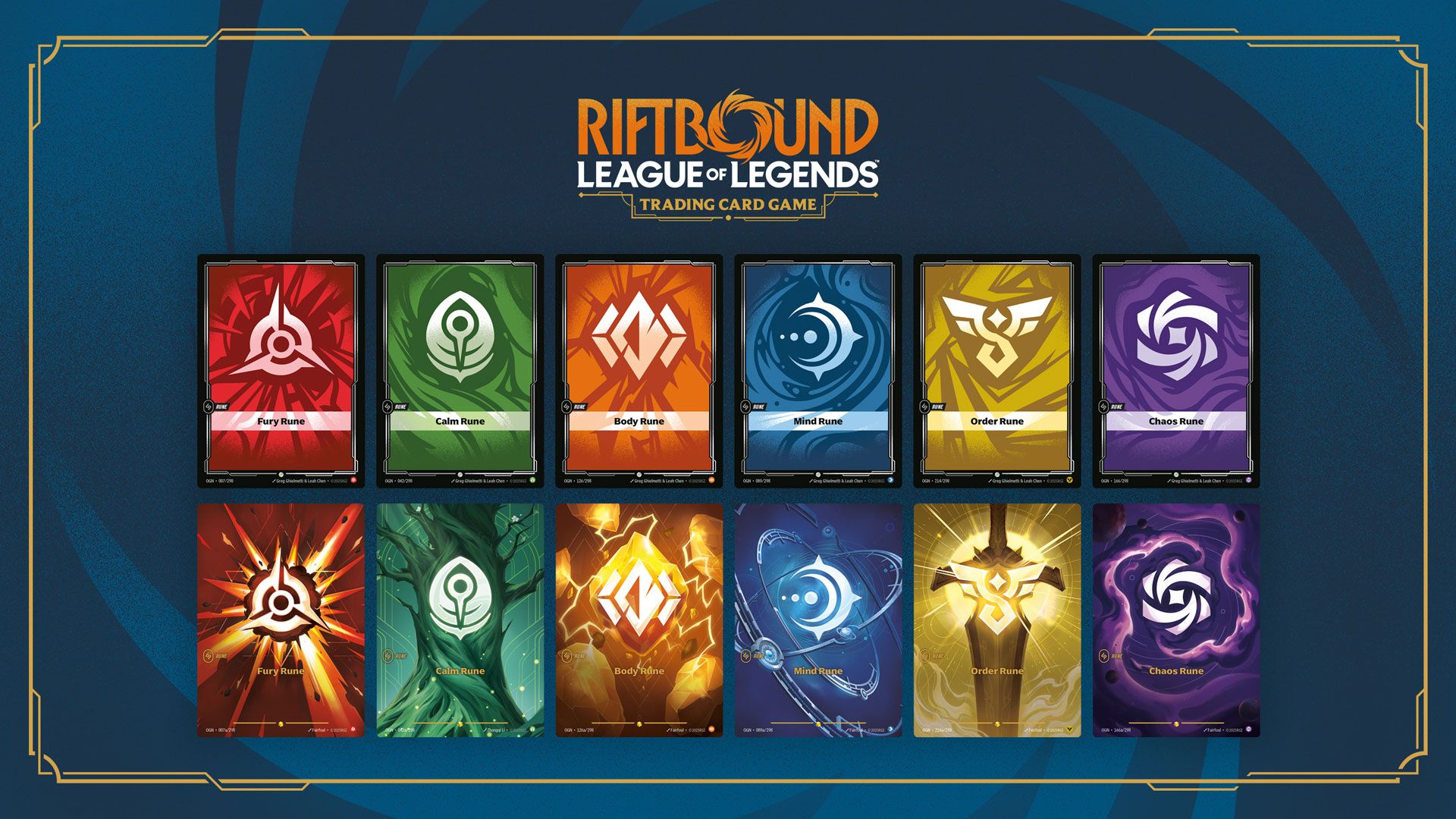
Most cards come with a cost, and in Riftbound, cost are paid with Runes. There are a total of 6 different type of Runes in Riftbound and they encompass all six Domains. Runes are placed and played separately from the main deck. The types of Runes you can have is based on your Champion Legend's Domain and you can have a total of up to 12 Runes in your Rune deck consisting of any combination of Runes available to you.When you are paying for costs, Energy costs will require you to simply tap any colour Runes as long as you pay the correct amount. Power Costs, on the other hand, specifically requires you to "RECYCLE", or put the card to the bottom of its respective deck, the corresponding Rune type for it.
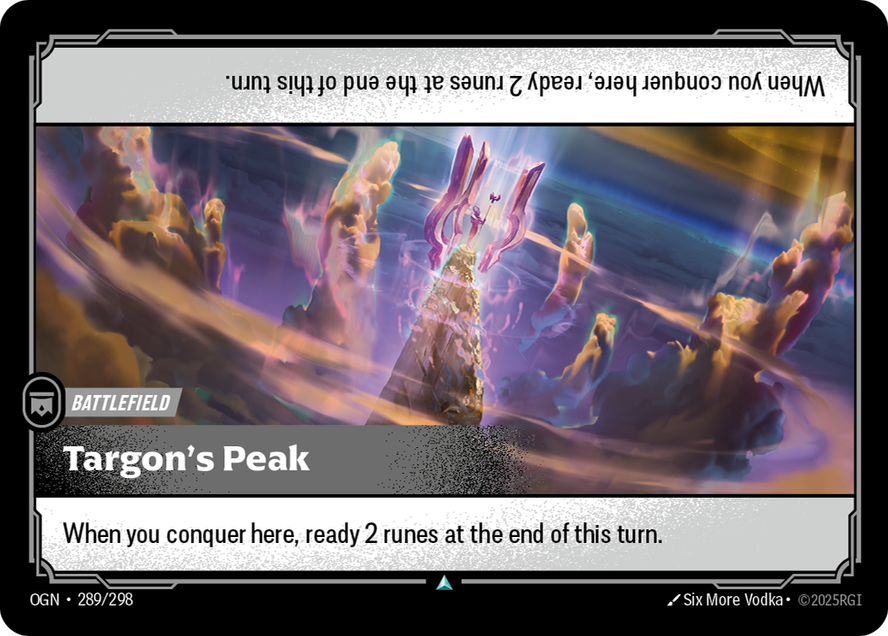
Lastly, we have battlefields. Battlefields are the locations where we can conquer or defend to score points. A deck will have up to 3 battlefields available to them but you can only play one each game. Battlefields are important not only because you need them for points, but also because conquering or defending them can give you perks that will help you win!
Building your Deck
Now that we have taken a look at all the cards available for us to use, it's time for us to build a deck! If you purchased a Starter Deck, such as the Jinx Starter Deck, you can easily skip this step and jump right into playing the game! But if you are interested in building your deck from scratch, let's have a quick look into how you can do that!

The most important step in building a Riftbound deck will be your Champion Legend. Your Champion Legend will have a huge impact on your play-style and card pool so make sure you check out all the Legends you have! Once you have chosen your Legend, you can look through all the Champion Units with the same name and within the Domains of your Legend (this means your Champion unit must be in the same Domain, either/or or both!). You also want to make sure your Chosen Champion has skills and abilities that can be useful for you! If you have purchased a Jinx Starter Deck at our store and are planning to upgrade the deck with Jinx Loose Cannon as your Legend, you now have the option to either keep Jinx, Demolitionist or change it to Jinx, Rebel.
You can have a maximum of three copies of any card in your deck, including your Chosen Champion. This means that if you were to use Jinx, Demolitionist as your Chosen Champion, you can have a total of two more Jinx, Demolitionist in your main deck! If you notice, in this Jinx Starter Deck, it includes another Champion (Vi, Destructive) that is not Jinx! This is because you can also use any other Champion Unit in your deck as long as the card is within your Legend's Domain.
Lastly, you must have a total of 40 cards in your main deck, including your Chosen Champion. With your Chosen Champion placed on the table, you will have a main deck of 39 cards to draw from!
Outside of your main deck, you will also have three battlefields and a separate Rune deck that is filled with just your Runes. You can have a total 12 Runes with any amount and combination of colours as long as they are all within your Legend's colour! Including your Legend, you will have 56 cards to play any game of Riftbound!
Setting up your Base

Once your deck is ready, it's time to play! Before we start a game of Riftbound, we need to first set up our board. Place your Legend and Chosen Champion on the side and your Main Deck of 39 cards below it. Then you can place your Rune Deck on the other end of the playing field from your Main Deck. You can also designate one area as your trash area (in other terms, your Graveyard of Discard pile). This layout is not a set rule so you can put the cards anywhere you want as long as it is clear to your opponent which area is which so place them wherever is most comfortable for you!
Depending on the match up or your strategy, you can then choose one battlefield and place it in-between your opponent and you. Riftbound has a unique method to decide who goes first beside just flipping a coin or high rolling dices. One of you or your opponent will shuffle up the battlefields and the other will choose one. The owner of the battlefield chosen will go first and players will take turns in a clockwise rotation! In a four-player game, the chosen battlefield will also be removed from the game as you can only have a maximum of up to three battlefields during any game.
Once you have returned the battlefields onto the board, it is now time to play! Each player will get to draw four cards from their Main Deck. If you are unsatisfied with your draw, you can choose to Mulligan where you return up to two cards from your hand to the bottom of the battlefield. Once you have returned the cards, you can draw as many cards as you returned this way. You can only Mulligan once in Riftbound so make sure to pay attention to your starting hand!
It is now time to start the game! In Riftbound, we always start the game with our ABCDs!
A - Awake: Ready all your cards, this includes your Units, Legends and Runes! (Untap all your cards.)
B - Beginning: This is where all your "start of turn" abilities resolve, and where you get your points for holding a battlefield!
C - Channel: You get to PUT two cards from the top of your Rune Deck onto the board, which we call Channeling. (In any Riftbound game, the LAST player gets to channel three Runes on their first turn.)
D - Draw: Draw one more card from your deck, this includes the starting player. (Only in four-player games, the first player does not get to draw a card on their first turn.)
Once we are done with our ABCDs, the Action can then truly begin as we enter our Action phase!
During our Action phase, we can do everything we want to (as long as it is within the game rules!).
Some of the things we can do during Action phase include:
- Playing cards, this includes Units, Spells and Gears! Don't forget to pay the cost By either exhausting or recycling your Runes!
- Activating card abilities, which includes any paid cost or triggers!
- Move your units to and from battlefields! Do note that only ready Units can move to and from battlefields. Units enter the game exhausted (unless stated otherwise) and every time they move, they also become exhausted!
Once you are done with your Action phase, you can end your turn. During this time, any "end of turn" abilities will trigger and all Units will heal to full health (this heals NON COMBAT DAMAGE only!). There is no maximum hand size in Riftbound so you get to keep your hand until your next turn!

Conquering your Battlefield
Did we just gloss over the most exciting part of the game? Maybe! If you noticed, there is no mention of fights or battles at all during the turn! But how can any form of League of Legends game have no combat?
This is because in Riftbound, Combat only happens when you move your Units to a battlefield that is already conquered!
A battlefield is considered conquered (however, your opponent will still have windows to react with Spells before the clean-up step!) as long as one or more Unit is moved into an empty battlefield. However, if you move your Unit to an occupied battlefield, Combat will trigger and a Showdown will begin to decide who gets the battlefield!

When a Showdown starts, you always resolve any “When I defend” abilities first, followed by any “When I attack” abilities. Players can still use any Reaction spells or abilities during this phase but not any Action spells or abilities. Once the “When I defend” and “When I attack” abilities have resolved, you can now start playing spells or activate other abilities.
It should be noted that during combat, you can only play spells or abilities with the keyword "ACTION". Any player can cast their ACTION spells or abilities during combat. In response, any other players can also add REACTION spells or abilities to the chain. Cards with the keyword "REACTION" are vital to combat as it resolves before ACTION cards do. ACTION cards all resolve individually and since REACTION are the only way to respond to ACTION cards, it becomes vital in disrupting your opponents.
In a recent rule change by Riot Games, the invite mechanic has been removed so any player in a game can play an ACTION card during combat! So if you are playing in a game mode with more than two players, you will need to pay attention to each Showdown!

Once all spells and abilities and triggers have resolved, you will then enter damage distribution part of a Showdown. Both conquering and defending players will add up all the Might of their Units and distribute the damage among the other's Units. The Might is both an indication of the damage you can deal and take. Your Might is a fixed value once it enters this part of Showdown and cannot be reduced by damage. Damage must also be distributed to each Unit one-by-one, meaning you must kill one Unit first before moving onto the next if there is excess.
There are also certain keywords that you need to pay attention to during combat. For example, Units with the keyword TANK will take all the damage first, so you will have to distribute all your damage to the TANK before moving onto other Units if there is excess.
There are many Keywords in Riftbound so make sure read your own cards and pay attention to your opponents!


Once damage is dealt, there will be four outcomes in Showdowns.
First: All the defending Units are dead. The Conquer is successful and the conquering player gain a point! Units heal from combat damage.
Second: All the conquering Units are dead. The Conquer is unsuccessful and nobody gets a point. The defending player will now hold the battlefield for one more turn. Units heal from combat damage.
Third: All Units are dead. The Conquer is unsuccessful and nobody gets a point. Units heal from combat damage.
Fourth: Both you and your opponents have units that are still alive. The Conquer is unsuccessful and nobody gets a point. The defending player will now hold the battlefield for one more turn. The conquering player will move their Units back to base. Units heal from combat damage.
Only when you first conquer a battlefield do you get a point. Defending players do not get points and you only get points for holding battlefields during the Beginning phase of your turn.
Once you reach 7 points, you stop gaining points from conquering battlefields. In Riftbound, you only win the game when you reach 8 points. However, the final 8th point in Riftbound can only be gained by two methods.
1 - You hold a battlefield during your Beginning Phase.
2 - You conquer all battlefields in play on the same turn.
This last-point rule gives extra tension to the board and gives a chance to any other player to catch up! So make use of this rule when you are behind!